adults living outside hospitals and care homes experience bowel leakage. Estimates vary.
[1]BOWEL HEALTH, WITH DIGNITY
More comfort.
More confidence.
One step at a time.
Bowel leakage can feel difficult to talk about. You are not alone, and you deserve support — without embarrassment or blame.
Grounded in clinical guidanceNo sign-up. Notes stay in this tab.

Room to feel like yourself againCare starts with being heard.
You deserve help
This is a health symptom, not a personal failing. A clinician is used to these conversations.
[2]Improvement is possible
Treatment can reduce symptoms. A complete cure is not always possible; better comfort and control still matter.
[3][5]01 / UNDERSTAND
A symptom. Not a definition of you.
Bowel control involves muscle strength, nerve signals, stool consistency and emptying. More than one factor may be involved. An assessment helps identify what needs attention.
[4][6]Does any of this sound familiar?
Choose a description to find words for your appointment. This is not a diagnosis.
When the urge feels too sudden
A strong urge can overwhelm bowel control. Tell your clinician about stool consistency, how long you can wait and whether this is a new change.
[1][5][6]A question you can take with you
“What is causing the urgency, and could stool adjustment or supervised retraining help?”
New or persistent symptoms deserve an appointment, even when the amount of leakage is small.
02 / WHAT CAN HELP
Start with care, not with pressure.
Many care plans begin without surgery. A clinician can combine the options that fit your symptoms, health and preferences.
[2][3]FIRST STEPS
Make stool easier to manage
Aim for soft, formed stool and comfortable emptying. A clinician can review food, fluids and medicines. Both diarrhoea and constipation can cause leakage.
SKILLED SUPPORT
Train the right muscles
A pelvic-health physiotherapist can check your contraction and relaxation, then adapt strength and coordination exercises to you.
DAILY COMFORT
Build a kinder routine
Discuss a predictable toilet routine, often after a meal. Give yourself privacy and enough time, without straining.
SUPPORT NOW
Protect skin and confidence
Gentle cleaning, patting dry, a suitable barrier product and absorbent pads can make day-to-day life easier while treatment begins.
And when first steps are not enough?
Specialist services can consider bowel irrigation or electrical stimulation for selected people; each needs assessment and training. Evidence for some other techniques is less certain. Implantable nerve stimulation involves a procedure — it is not a home exercise or a fully non-invasive option.
[4][5]03 / GENTLE PRACTICE
Small movements. No forcing.
The goal is a useful, well-controlled movement — not a stronger squeeze at any cost.
seconds remaining
At your own pace
Give yourself a little space
Sit comfortably with your feet supported. Let your shoulders soften and breathe at your natural pace. There is no need for deep breaths or breath-holding. This is a comfort pause, not a treatment for leakage.
Stop if you feel dizzy or uncomfortable. No need to follow the circle with your breath.
[7][9]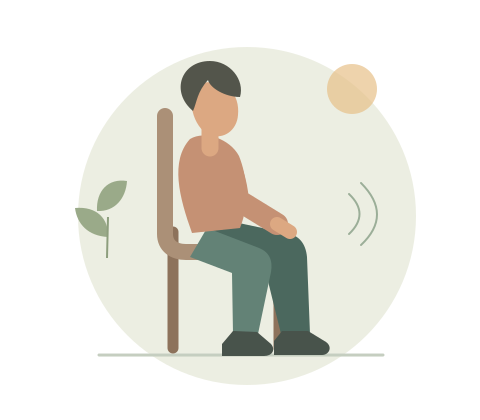
Think “close and gently lift”
Practise the movement a clinician has shown you, away from the toilet. Imagine holding back wind: gently close and lift around the anus. Keep your abdomen, buttocks and thighs relaxed; keep breathing.
- Sit or lie in a comfortable, supported position.
- Feel a gentle inward lift — not a downward push.
- Release fully. Relaxation matters as much as contraction.
Stop with pain, increased bleeding or a worsening bulge. Difficulty feeling the movement is a reason to ask for help, not to squeeze harder.
[6][7]Your programme should fit you
After checking technique, your therapist may prescribe slower holds for endurance and brief squeezes for quick control. Hold times, repetitions and rest periods should be individual — this page does not prescribe a universal dose.
These are conversation prompts, not medical clearance.
Progress may take weeks or months. If symptoms persist, review the plan rather than pushing harder. Difficulty is not a failure.
[7][8]04 / YOUR NEXT STEP
You do not need to explain everything perfectly.
Start with one sentence. Then choose the questions you would like to bring to a clinician.
“I am having trouble controlling my bowels. It is affecting my daily life, and I would like help.”
0 / 5 questions selected
Selections and notes stay in this tab only. They are not saved or sent. Reloading clears them; a file you download or print is yours to keep private.
A FEW REASSURING ANSWERS
Questions that are worth asking.
Is this simply a normal part of getting older?
Bowel leakage becomes more common with age, but that does not mean it should be dismissed. People of different ages can be affected, and assessment may reveal treatable contributors.
[1][2]Can I improve without surgery?
Yes, non-surgical treatments can help. Your response depends on the cause. A better stool pattern, specialist rehabilitation and practical support may reduce symptoms; no single method works for everyone.
[3][5]Should I just do more Kegel exercises?
Not necessarily. Exercises target the voluntary outer sphincter and pelvic floor. They do not directly exercise the automatic inner sphincter or fix every nerve or structural problem. Technique and the right diagnosis matter.
[6][8]WHEN NOT TO WAIT
Some changes need prompt medical help.
Do not assume new bleeding is just haemorrhoids. This page cannot assess an emergency.
THE SCIENCE BEHIND THE SUPPORT
Clear guidance. Open sources.
This independent educational page draws on the sources below. Links were checked on 16 October 2026; that is a checking date, not a claim that every guideline was published in 2026. No individual clinician review is claimed.
- 01NIDDK · How common bowel leakage is
- 02NHS · Bowel incontinence and seeking care
- 03NIDDK · Treatment options
- 04NICE CG49 · Individual assessment and management
- 05ASCRS · Fecal incontinence guideline (2023)
- 06Cambridge University Hospitals · Bowel control
- 07Cambridge University Hospitals · Exercises and technique
- 08Cambridge University Hospitals · Physiotherapy bowel management
- 09Cambridge University Hospitals · Improving bowel function
- 10ASCRS · Rectal prolapse
- 11NHS · Rectal bleeding
- 12NHS · Blood thinners and bleeding
- 13Johns Hopkins Medicine · Rectal prolapse and complications